
As the construction industry accelerates towards net zero carbon buildings, attention is increasingly focused on the embodied carbon of all building systems, not just structure and energy use. Fire detection and alarm systems are essential life safety measures, yet their environmental impact has historically been poorly understood or excluded from whole life carbon assessments.
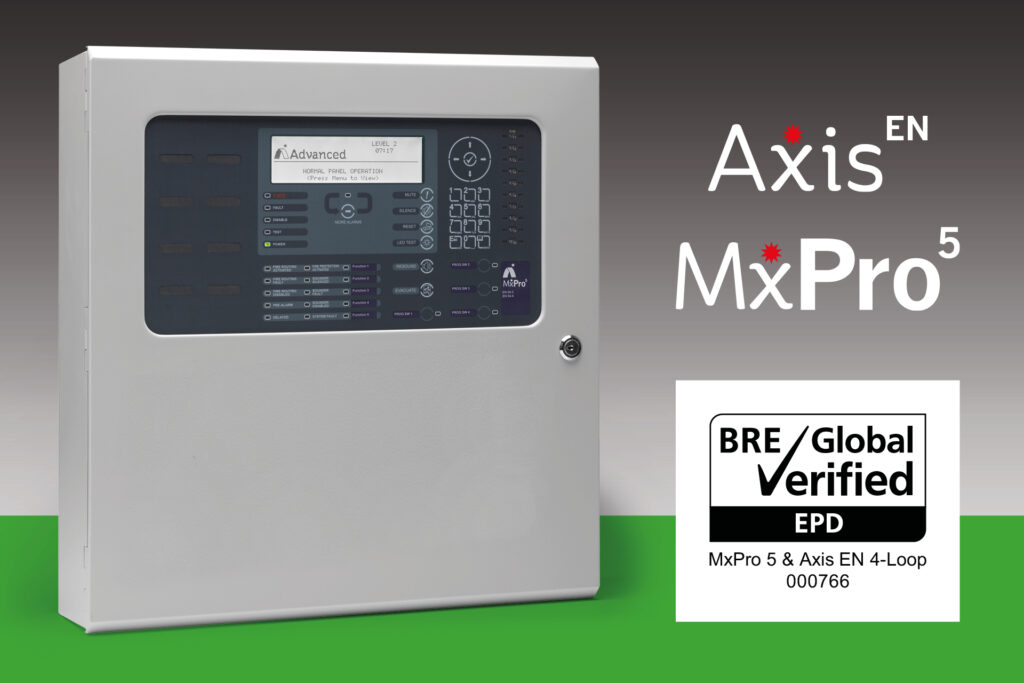
This concern is being actively addressed by open-protocol fire panel manufacturer Advanced, and Apollo Fire Detectors. Both companies now hold Environmental Product Declarations (EPDs) – Advanced for its MxPro 5 four-loop fire panels and Apollo for its Soteria range of heat, optical and multi‑sensor detectors. When combined as a system, an end-to-end carbon footprint calculation can be made to meet any requirement for system-level carbon impact data.
An Environmental Product Declaration is a third‑party verified, standardised document that reports the environmental impacts of a product across its full lifecycle, based on a robust life‑cycle assessment (LCA) and developed in line with internationally recognised standards such as EN 15804 and ISO 14025. EPDs typically cover raw material extraction, manufacturing, transport, use, and end‑of‑life treatment, providing consistent and comparable data.
Across construction, EPDs are already commonplace for materials such as concrete, steel and insulation. However, fire detection and alarm systems have lagged behind, largely due to the complexity of electronic products and a historic lack of demand for detailed carbon data in life‑safety systems. As a result, embodied carbon has often been estimated using generic tools or excluded altogether.
This gap is becoming increasingly problematic. As operational energy use is reduced, embodied carbon represents a growing proportion of total building emissions. Achieving genuinely low‑carbon buildings requires that all contributors are measured and understood, including systems installed solely to protect life and property.
EPDs address this challenge by providing credible, product‑specific data. They support sustainability‑led specification, improve the accuracy of whole‑building carbon assessments, inform BIM‑based design comparisons, and strengthen the credibility of environmental reporting.
Advanced: transparency at the control panel level
Advanced has taken a significant step by achieving an independently verified EPD for its MxPro 5 four loop fire alarm control panels, becoming the first manufacturer in its sector to do so. Verified by BRE Global, the EPD provides transparent lifecycle data covering environmental impacts from manufacture through to end of life.
The declaration applies across the full range of four loop panel variants, ensuring consistent data for specifiers and consultants. This enables accurate inclusion of fire alarm control panels within embodied carbon calculations, reducing uncertainty for project teams undertaking whole life carbon assessments. Development of additional EPDs for other panels is currently under review.
Apollo: Progressing EPDs for fire detection devices
Apollo Fire Detectors has also highlighted the growing importance of EPDs within fire detection. While EPDs are still relatively new in this sector, Apollo has achieved EPD certification for key detection products, including its Soteria range of heat, optical and multi‑sensor detectors. Apollo is actively working towards expanding EPD coverage to include interfaces, sounders and the wider Soteria / intelligent product range by the end of 2027. These declarations provide verified, product‑specific carbon data where previously only estimates were available.
While interim approaches such as CIBSE TM65 have helped bridge data gaps, Apollo recognises that EPDs represent the future, offering greater accuracy, transparency and confidence as regulatory and market expectations continue to rise.
From product data to system‑level insight
Fire safety systems comprise multiple interdependent components. Understanding the carbon impact of a single product only tells part of the story.
By gaining EPDs across complementary products, when combined, Advanced and Apollo enable a more complete, system-level understanding of embodied carbon. When both fire alarm control panels and detection devices carry verified EPDs, designers and consultants can quantify the embodied carbon of complete fire detection and alarm systems with far greater confidence.
The availability of compatible, EPD-certified panels and detection supports better decision-making at early design stages, when the opportunity to influence embodied carbon is greatest.
Alignment with the UK Net Zero Carbon Buildings Standard
The importance of verified data for fire safety is underscored by the UK Net Zero Carbon Buildings Standard (2026), a new framework that emphasises both operational and embodied carbon, relying on EPDs to ensure net‑zero claims are robust. For projects aiming to meet this Standard, all systems, including life‑safety, must be included in carbon calculations alongside structure and MEP. Therefore, EPDs for fire panels and detectors are crucial for credible whole‑building carbon assessments under this framework.
Conclusion
The rising adoption of EPDs marks an important shift in the fire safety sector. Through collaboration and leadership, Advanced and Apollo are demonstrating how manufacturers can deliver transparency and system‑level carbon insight to support net‑zero goals. As initiatives like the UK Net Zero Carbon Buildings Standard raise the bar, integrating fire safety systems into whole‑life carbon planning will become standard practice. With verified EPDs and a shared commitment to sustainability, the fire sector is well positioned to contribute to safer, lower‑carbon buildings.